

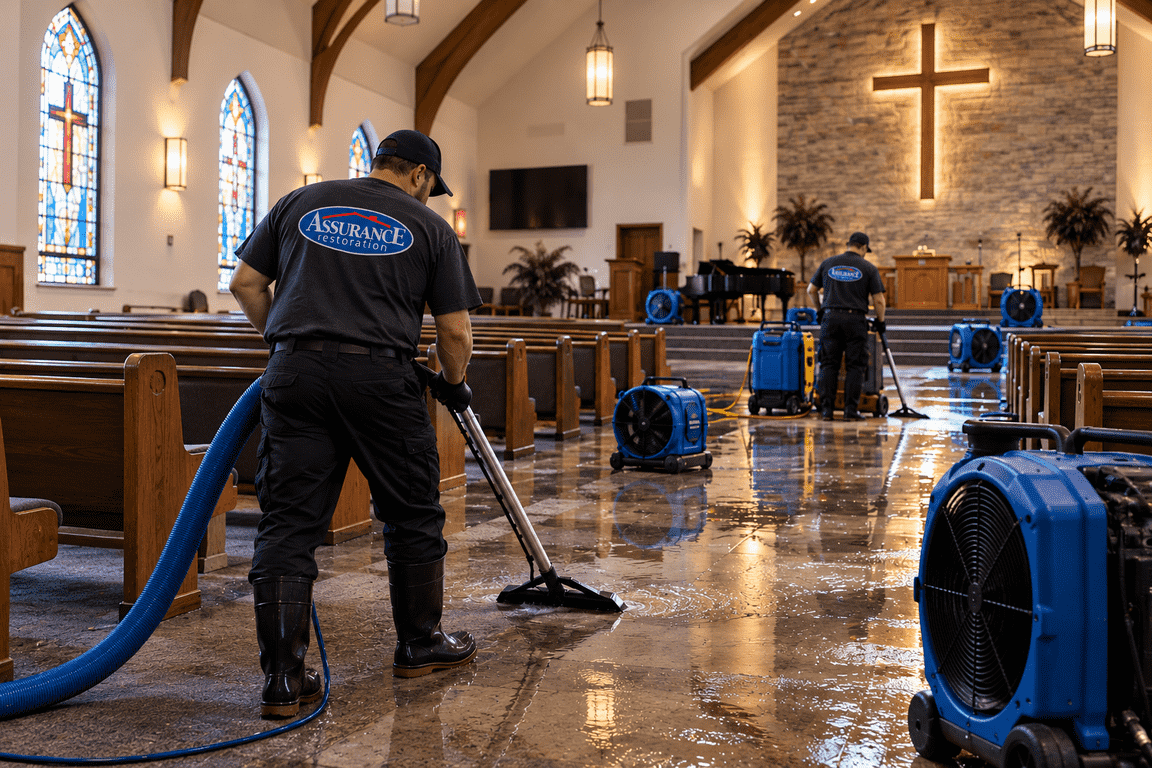
A church isn't just a building. It's where people gather, mark milestones, find community, and show up for each other during hard times. When flooding hits, the disruption goes well beyond damaged drywall and wet carpet.
A burst pipe in the fellowship hall, a roof leak above the sanctuary, heavy rainfall working through compromised flashing — water doesn't care what the space is used for. It moves fast, and the decisions made in the first few hours shape how much of the building and its contents can be saved.
Assurance Restoration provides professional church water damage restoration in Tulsa and surrounding Oklahoma communities, helping religious facilities get stabilized, dried, and restored so congregations can get back to normal.
First Things First — Safety Before Cleanup
The instinct when water enters a building is to start cleaning. That's the wrong first move.
Before anyone — staff, volunteers, congregation members — enters the affected area, a few things need to happen:
Stop the source. If the flooding came from a broken supply line or plumbing failure, find the shutoff valve and stop the flow. For storm-related intrusion or roof leaks, stay out of areas where ceilings look unstable or electrical hazards are possible. Standing water and submerged wiring are a serious combination.
Close off affected spaces. Flooded sanctuaries, classrooms, kitchens, and offices stay closed until conditions are properly evaluated — especially if the water may contain sewage, stormwater, or other contaminants.
Document before touching anything. Photograph and video every affected room, wall, floor surface, piece of furniture, and piece of equipment while it's safe to do so. Keep records of damaged items. Don't discard anything before it's documented unless safety requires it.
Call a professional restoration company. The sooner extraction and drying begin, the more of the building and its contents can be saved. Every hour of delay is another hour moisture is working deeper into building materials.
Why Churches Require a Different Restoration Approach
A residential water loss is straightforward by comparison. Churches involve large open spaces, multiple connected rooms, specialized furnishings, sound systems, musical instruments, children's areas, and materials that can't be treated the same way as standard drywall and flooring.
Water in a church can affect:
- Sanctuary carpeting, pews, and upholstered seating
- Fellowship halls, kitchens, and dining areas
- Children's classrooms and nursery spaces
- Musical instruments, sound systems, and electrical equipment
- Offices, storage rooms, and records
- Drywall, insulation, subflooring, and structural materials
Water also travels beneath carpeting, behind baseboards, and into wall cavities without leaving visible signs on the surface. Church flood cleanup needs to address what's hidden just as much as what's obvious.
What Professional Church Water Damage Restoration Actually Involves
Once the safety concerns are addressed, restoration focuses on stabilizing the property and preventing additional damage from taking hold.
Extraction and moisture detection come first. Technicians remove standing water with professional extraction equipment, then use moisture meters and detection tools to map where water traveled into building materials and beneath flooring — because the visible water is never the complete picture.
Structural drying and dehumidification follow. Commercial air movers and dehumidifiers get positioned throughout affected spaces. Moisture levels get monitored as drying progresses. Opening windows and running building HVAC doesn't dry a structure — professional equipment does.
Cleaning and material evaluation determine what stays and what goes. Not everything touched by water automatically needs replacement. Depending on the water source, how long materials were exposed, and what condition they're in, some furnishings and building components can be professionally cleaned and restored. Carpet and upholstery cleaning can address certain affected areas. Heavily saturated or contaminated materials get removed. The actual conditions on site drive those decisions — not assumptions.
When the Water Came From a Storm
Oklahoma churches face real property risk during severe weather seasons. Damaged roofing, compromised flashing, clogged drainage, and broken windows can all allow significant water intrusion during heavy rainfall events.
Storm-related flooding involves more than extracting water from floors. The source of intrusion has to be found and addressed before drying can actually hold. Storm damage repair gets coordinated with water mitigation when severe weather is the cause — because fixing the interior without fixing what let the water in just delays the next event.
Church administrators should also know that stormwater and sewage-contaminated water require additional cleaning procedures and material removal beyond what a clean water loss involves.
Can Water Damage Interrupt Church Services?
Yes — and it often does. A flooded sanctuary may require services to move temporarily. Kitchen or fellowship hall damage can shut down food programs, community events, and meetings. Water in children's classrooms creates additional scheduling challenges.
When planning the restoration, communicate upcoming activities and events to the restoration team. Depending on where the damage is and how severe, it may be possible to prioritize certain areas or schedule work around the calendar. What isn't negotiable: reopening should depend on whether spaces are safe and properly restored — not whether the visible water is gone.
When a Church Needs Reconstruction After Flooding
Some water losses go beyond what drying and cleaning can resolve. Prolonged moisture exposure damages drywall, insulation, flooring, cabinetry, trim, and structural materials in ways that require removal and replacement.
Reconstruction services help religious facilities move from emergency cleanup into permanent repairs — coordinating mitigation and rebuild so multiple areas of the building can be restored with minimal ongoing disruption to operations.
Preparing for the Next Water Emergency
Not every flooding event can be prevented. Having a basic response plan in place means church leadership can act quickly rather than figure it out under pressure.
Some practical steps worth taking now:
- Inspect roofing, gutters, and drainage systems on a regular schedule
- Identify and clearly mark the building's main water shutoff valves
- Periodically check restrooms, kitchens, and mechanical rooms for slow leaks
- Keep important documents and valuable equipment out of flood-prone storage areas
- Maintain current emergency contact information for facility managers and restoration professionals
- Establish a communication plan for staff, volunteers, and congregation members before an emergency happens
For larger facilities with multiple buildings, assign clear responsibility for emergency response so there's no confusion about who makes the call when something goes wrong.
Professional Church Water Damage Restoration in Tulsa
A flooded church presents a combination of challenges that residential water damage doesn't — protecting specialized furnishings, restoring gathering spaces, and minimizing interruptions to programs and services that communities depend on.
Responding quickly, finding hidden moisture, and completing the right repairs in the right order are what keep a manageable water emergency from becoming a months-long restoration project.
Contact Assurance Restoration if your Tulsa church has experienced flooding, a plumbing emergency, or storm-related water damage. The team handles commercial water damage restoration throughout Tulsa and surrounding communities — extraction, drying, storm damage repair, cleaning, and reconstruction all coordinated under one roof.