

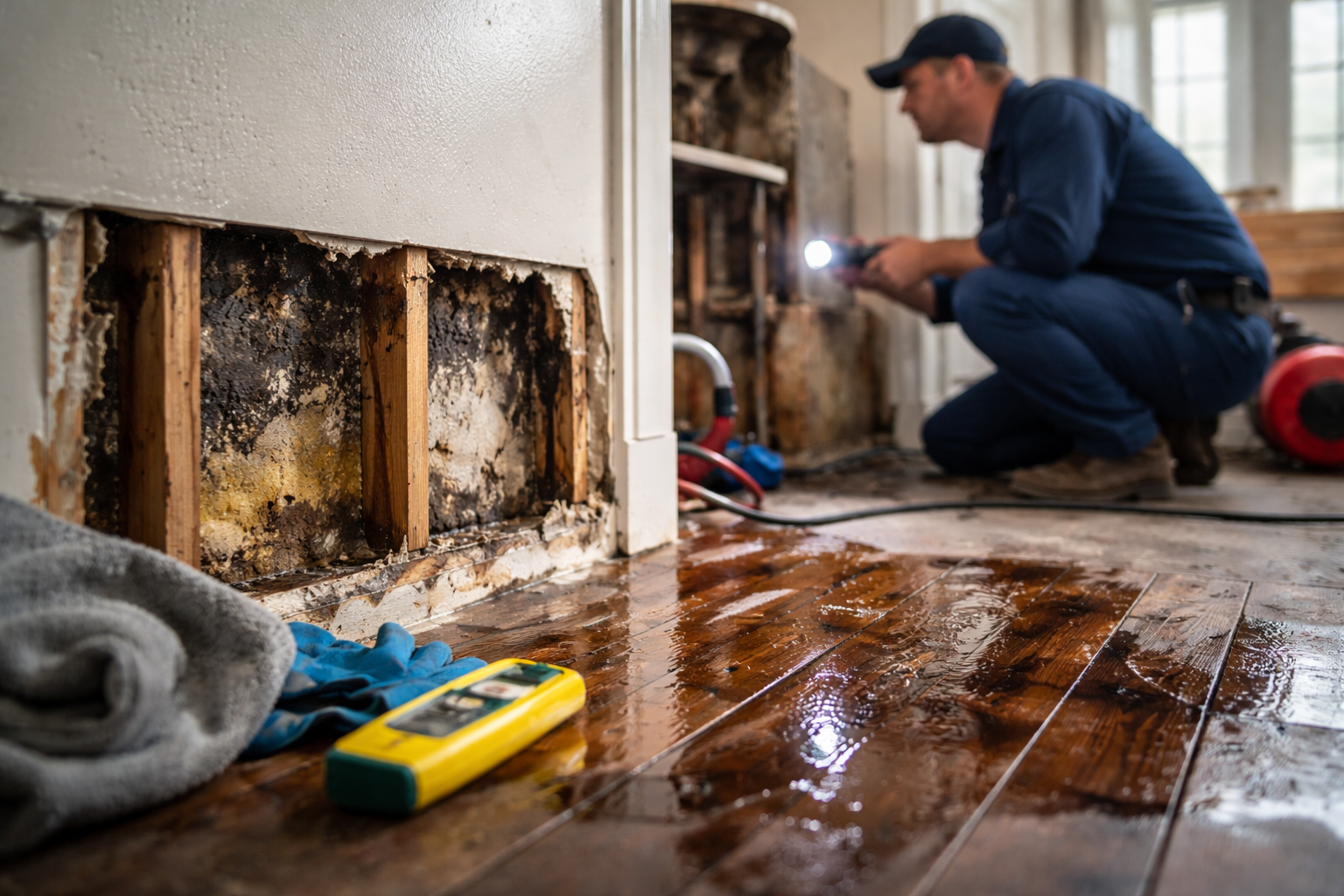
Hidden water damage is expensive because it stays quiet.
You don't see it pouring through the ceiling. You don't step into a puddle. Instead, it works behind drywall, under floors, and above ceilings—slow, steady, and destructive.
In Tulsa homes, that's common. Storms roll through. Pipes age. Foundations shift. Moisture finds a way in. The question isn't whether water can cause damage. It's whether you catch it early.
The First Clue Is Often Your Water Bill
A sudden spike in your water bill with no change in usage isn't random.
It usually means one of two things: a running fixture you haven't noticed—or a hidden leak. Slab leaks, pinhole copper failures, and slow supply-line drips can waste thousands of gallons before you ever see a stain.
And while you're paying for that water, it may be:
- Saturating subflooring
- Softening framing
- Feeding mold inside walls
- Weakening insulation
That's when professional hidden water leak detection becomes critical. Catching it early often means drying and repair. Catching it late can mean reconstruction.
If you're unsure, this is where experienced water damage restoration professionals step in.
Smell Is a Signal
Homes shouldn't smell damp.
If one room has a musty odor that won't go away—even after cleaning—moisture is likely trapped somewhere. Behind drywall. Under carpet padding. Inside HVAC chases.
Tulsa's humidity doesn't help. Moisture plus warm air equals ideal mold conditions. And mold doesn't need an invitation.
Once growth starts, proper mold remediation isn't optional. It requires containment, filtration, and controlled removal—not bleach and hope.
If the smell lingers, don't ignore it.
Stains Don't Lie
Water rarely drips straight down. It travels along beams, insulation, and drywall seams before it shows itself.
You might notice:
- A faint yellow ring on the ceiling
- Paint bubbling near a window
- Drywall tape separating
- Trim pulling away from the wall
After heavy weather, this often ties back to roof or exterior damage. Tulsa storms can push rain sideways, not just downward. That's when interior drying and storm damage restoration overlap.
Small stain today. Structural repair tomorrow. That's the progression.
Floors Tell the Story Fast
Flooring reacts quickly to moisture.
Hardwood begins to cup. Laminate bubbles. Tile loosens as the subfloor swells underneath. Carpet padding traps moisture long after the surface feels dry.
Professional moisture mapping tools identify how deep the problem runs. In many cases, targeted drying combined with carpet cleaning or content cleaning can preserve materials you thought were ruined.
Wait too long and replacement becomes unavoidable.
Mold in the Corners Means Moisture Somewhere
Mold growth isn't random. It follows water.
Dark spotting around baseboards, under sinks, or near vents signals consistent moisture exposure. Tulsa homes with older plumbing or minor foundation shifts are especially vulnerable.
Mold affects more than surfaces. It impacts indoor air quality. It spreads through HVAC systems. It creates health concerns for families with allergies or asthma.
When you see it, the moisture source needs to be found—not just cleaned.
Foundation Shifts and Hidden Entry Points
Tulsa's clay soil expands and contracts. That movement stresses foundations and exterior walls. Hairline cracks turn into water pathways during heavy rain.
Over time, repeated intrusion weakens structural materials. At that stage, drying alone may not be enough. Coordinated reconstruction or structural repair may be necessary after mitigation.
Water doesn't need a large opening. It only needs consistency.
When It Turns Into an Emergency
Some situations escalate immediately.
- Sewage backups requiring professional sewage cleanup
- Major flooding needing emergency water removal
- Fire suppression water overlap with fire damage restoration and smoke damage cleanup
- Hazardous contamination requiring biohazard cleanup
In those cases, response time changes everything. The faster containment happens, the smaller the rebuild.
The Cost of Waiting
Hidden water damage compounds.
A small leak doesn't stay small. Moisture spreads laterally through porous materials. Mold colonizes. Wood weakens. Insulation collapses.
What could have been localized water damage remediation services becomes:
- Structural framing repair
- Full drywall replacement
- Flooring removal
- Extended drying timelines
Quick action limits scope.
Why Professional Detection Matters
You can't fix what you can't see.
Restoration teams use:
- Infrared thermal imaging
- Pin and non-penetrating moisture meters
- Hygrometers
- Controlled structural drying systems
These tools identify moisture inside walls and beneath surfaces without unnecessary demolition. That precision protects both property and budget.
Assurance Restoration provides complete water, mold, and fire damage restoration services in Tulsa and surrounding areas. Mitigation, cleanup, and rebuild are handled under one coordinated process.
You can see more about their standards and approach on the About Us page.
Protect Your Tulsa Home
Hidden water damage doesn't fix itself. It grows quietly until it becomes expensive.
Watch your water bill. Trust unusual smells. Pay attention to subtle stains and soft flooring. Small clues matter.
The earlier moisture is identified, the more options you have.
If you suspect hidden water damage in your Tulsa home, get it checked before it spreads.
Assurance Restoration provides experienced water damage restoration in Tulsa and mitigation services designed to protect your home's structure and air quality.
Schedule an inspection or request immediate help through the Contact page.
Fast response today prevents major reconstruction tomorrow.