

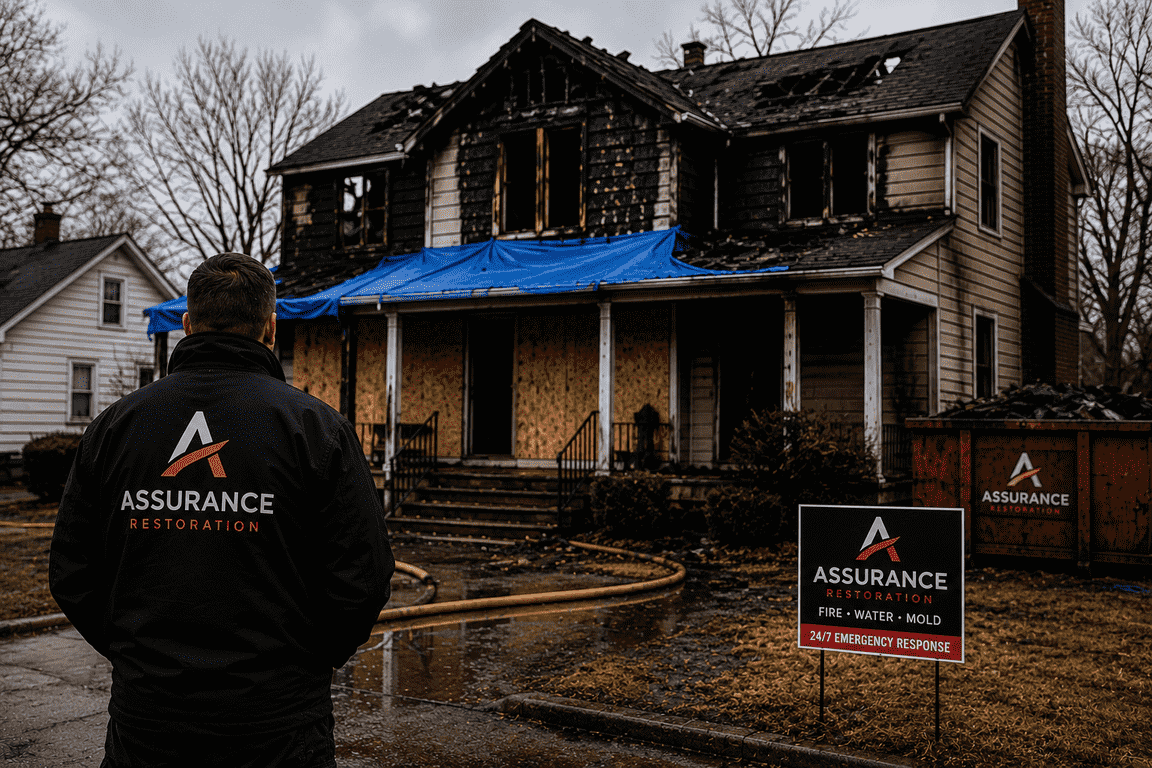
The fire is out in minutes. Getting your home back takes considerably longer.
The first question most homeowners ask after the trucks leave is how long this is going to take. The real answer: it depends on the fire. A contained kitchen fire might wrap up in a few weeks. A major structural loss can stretch to several months. What consistently shortens that timeline is having an experienced restoration team moving quickly through each phase — and not losing days between them.
Here's what the process actually looks like, start to finish.
Hours 1–48: Stop the Bleeding
Before any rebuilding starts, the property has to be stabilized. Broken windows get boarded. Compromised roofs get tarped. Standing water — and there's usually a significant amount of it after a structure fire — gets extracted immediately.
That last point surprises most people. Thousands of gallons of water can be used to suppress a house fire, and that moisture soaks into flooring, insulation, drywall, and framing fast. Water damage restoration becomes part of the fire recovery process whether homeowners plan for it or not. Left untreated, that moisture creates mold within 24 to 48 hours — adding a remediation project on top of an already significant rebuild.
The faster mitigation starts, the less it costs and the shorter the overall timeline.
Days 2–7: Assessment and Debris Removal
Once the property is stabilized, restoration professionals conduct a detailed inspection — not just of what burned, but of where smoke traveled, how deeply soot penetrated, what systems were affected, and which materials and belongings can still be saved.
This is also when insurance documentation happens. A thorough damage assessment that's properly documented moves the claims process forward. Companies experienced in fire damage restoration handle that documentation directly, which removes a significant burden from homeowners who are already dealing with enough.
Debris removal and demolition of unsalvageable materials runs parallel to the assessment phase.
Week One: Smoke and Soot Removal
Removing burned materials doesn't end the damage. Soot is acidic — it keeps etching surfaces, corroding metals, and staining finishes long after the fire is out. Smoke penetrates HVAC systems, wall cavities, and attic spaces in ways that aren't obvious from a walkthrough.
Professional smoke and soot cleanup uses specialized equipment and methods that standard cleaning can't replicate. Walls, ceilings, cabinets, flooring, and ductwork all get treated. The goal is complete contamination removal — not surface-level cleaning that leaves residue to cause problems later.
Personal belongings are assessed during this phase too. More can be saved than most homeowners expect. Content cleaning services can restore furniture, clothing, photographs, and electronics if the process starts before smoke residue permanently bonds to those items.
Week Two: Odor Elimination
Visible soot gone doesn't mean the smoke is gone. Odor particles embed in insulation, carpeting, drywall, and ductwork — and they don't respond to air fresheners or standard cleaning products.
Commercial odor elimination uses thermal fogging, hydroxyl generators, HEPA filtration, and ozone treatment to neutralize particles rather than mask them. This phase takes several days depending on how deeply smoke worked its way into the structure. Skipping or shortcutting it means the smell comes back — usually when the heat of summer activates whatever residue was left behind.
Weeks Three Through Eight: The Rebuild
Once mitigation and cleaning are complete, reconstruction begins.
Minor losses might only require drywall replacement, new flooring, cabinet work, and paint. Major structural fires involve framing repairs, roof replacement, electrical rewiring, plumbing, HVAC, and complete room reconstruction. Full fire reconstruction managed by a single team — the same company that handled mitigation — moves faster and has fewer gaps than projects handed off between separate contractors.
Building code compliance gets handled during reconstruction, not after. An experienced restoration contractor manages that process so homeowners aren't chasing permits and inspections on their own.
What Makes Timelines Longer
A few things reliably extend fire restoration projects:
- Extensive structural damage that requires engineering review before rebuilding starts
- Water damage that wasn't fully dried in the mitigation phase, leading to mold that has to be addressed before reconstruction
- Insurance approval delays when documentation isn't complete or organized
- Specialty materials with long lead times
Having one company manage mitigation, documentation, cleanup, and rebuild under a single contract eliminates most of the coordination delays that slow multi-contractor projects down. If you want to understand more about how hidden moisture affects rebuild timelines specifically, this breakdown of water damage in Tulsa homes covers the details.
Recovery Has a Starting Point
The timeline is real, and it's not always short. But every day the process doesn't start is a day soot keeps working, moisture keeps spreading, and the rebuild gets more complicated.
If your Tulsa home has experienced fire, smoke, or water damage from firefighting efforts, contact Assurance Restoration to get an assessment scheduled and a recovery plan in place. The sooner the process starts, the better the outcome — for the property, the timeline, and the budget.